RudraM-II passes crucial test as India sharpens indigenous strike capability
The successful RudraM-II trials validated multiple critical systems and highlighted collaboration between DRDO laboratories, the Indian Air Force and industry partners.
India has successfully tested the indigenous TARA glide weapon system, marking a key step in low-cost precision strike capability and defence self-reliance.




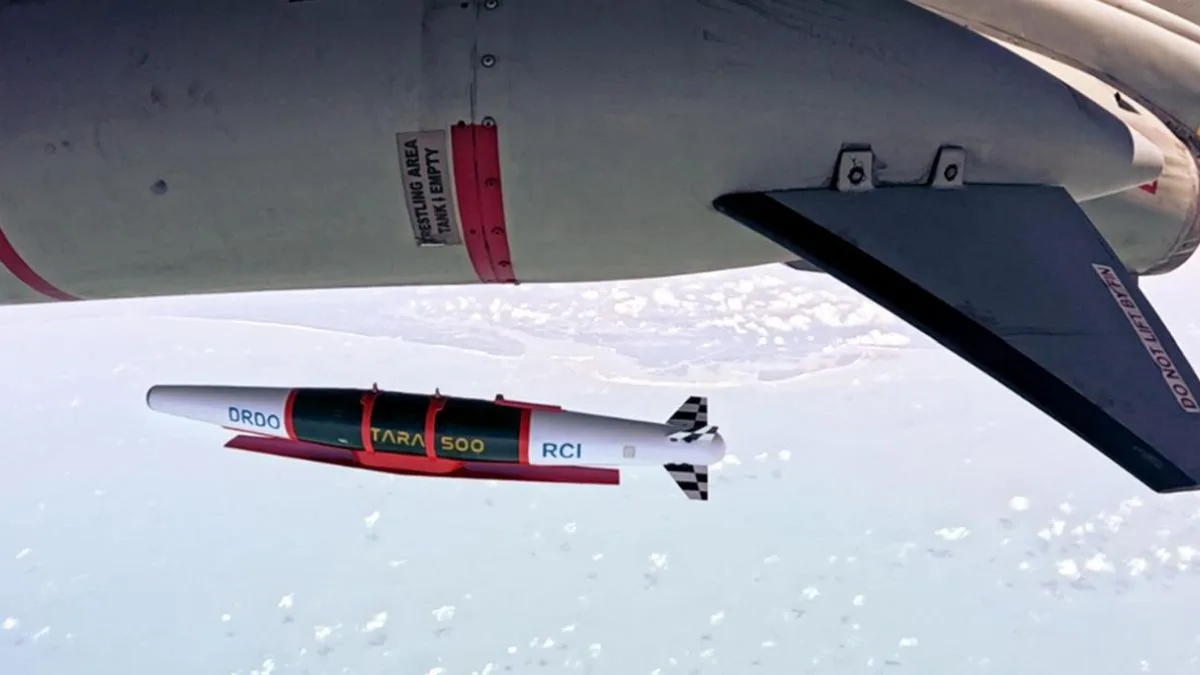
DRDO and the Indian Air Force conduct the maiden flight-trial of the Tactical Advanced Range Augmentation (TARA) weapon off the Odisha coast. | PIB
India on Thursday successfully carried out the maiden flight-trial of the Tactical Advanced Range Augmentation (TARA) weapon, a new indigenous glide weapon system designed to convert conventional unguided warheads into precision-guided weapons.
The trial, conducted jointly by the Defence Research and Development Organisation (DRDO) and the Indian Air Force (IAF) off the Odisha coast, marks another step in India’s push to build low-cost indigenous precision strike capability at a time when modern warfare is rapidly shifting towards smarter and more accurate weapons systems.
Advertisement
According to the Ministry of Defence, TARA is India’s first indigenous glide weapon system and has been developed by Hyderabad-based Research Centre Imarat (RCI) along with other DRDO laboratories.
Advertisement
Unlike conventional free-fall munitions, glide weapons use aerodynamic surfaces and guidance systems to travel farther and strike targets with greater precision after release.
Officials said TARA has been designed to improve the lethality and accuracy of low-cost weapons aimed at neutralising ground-based targets.
In a post on X, DRDO said: “Maiden flight-trial of Tactical Advanced Range Augmentation (TARA) weapon was successfully conducted off the coast of Odisha on May 07, 2026.”
The organisation described TARA as a “modular range extension kit” capable of converting unguided warheads into precision-guided weapons.
Military experts increasingly view glide weapon systems as cost-effective force multipliers because they enhance the capability of existing munitions without requiring entirely new missile platforms.
Officials said TARA is also the first indigenous glide weapon to utilise state-of-the-art low-cost systems, underlining India’s broader focus on scalable and affordable precision-strike technology.
The system has been developed with Development cum Production Partners (DcPP) and other Indian industries, with production activity already underway.
For India, the project is also closely tied to the government’s larger self-reliance push in defence manufacturing under the “Atmanirbhar Bharat” initiative.
Defence Minister Rajnath Singh congratulated DRDO, the IAF, DcPP and industry partners for the successful trial, calling it “a significant development in advancing India’s indigenous defence capabilities”.
DRDO Chairman and Secretary, Department of Defence R&D, Samir V Kamat also congratulated the teams associated with the programme.
Earlier this week, Rajnath Singh said the government had placed defence research at the centre of its priorities and noted that DRDO had transferred 2,200 technologies to industries.
Addressing the North Tech Symposium, the Defence Minister said 25 per cent of the defence R&D budget had been allocated to industry, academia and start-ups. According to him, these entities have already utilised more than Rs 4,500 crore.
Defence developments involving precision-guided systems are closely watched across the region, particularly by neighbouring countries monitoring India’s military modernisation efforts.
Precision-guided glide weapons can improve strike accuracy and allow aircraft to engage targets from safer distances, making them an increasingly important component of modern aerial warfare.
For countries like Pakistan and China, India’s progress in indigenous precision-strike technology is likely to be viewed as part of a broader military modernisation effort focused on reducing dependence on imported systems.
Globally, glide weapon kits have become an important part of contemporary conflicts because they offer relatively low-cost precision strike capability compared to expensive long-range missile systems.
The Defence Ministry, however, described the TARA trial primarily as a technological and industrial milestone linked to indigenous capability building.
Advertisement